
By
Dan Russo
•
This year (2023) will mark the 15-year anniversary of the global financial crisis, which also ushered in the worst economic downturn in the U.S. since the Great Depression and one of the worst bear stock markets in recent history. Those who lived through that troubling period (like us) remember the extreme swings in volatility and the compounding losses. Beyond the bouts of volatility, there was also a feeling of being ground down as rally attempts regularly failed. When the bear market finally bottomed out in March 2009, the S&P 500 Index had shed 56% of its value.
A bear market of that magnitude is rare-according to Yardeni Research, only one other bear market since 1929 has been worse. (That was between 1930-32, when the S&P 500 lost 83% of its value.) However, Investors should pay attention to the magnitude of losses, perhaps more so than their frequency, because of the time it takes to recover from these kinds of extreme losses.
In the case of that 2008 bear market, it took around four years for the S&P 500 to make up all its lost ground. The S&P 500 did not break to a new all-time high until March 2013. Add to that the 517 days from peak-to-trough of the bear market itself, and you get a total of five-and-a-half years of time lost trying to reclaim market value.
Lessons Learned
When investors are just getting started with their investment plans, usually through a workplace retirement plan like a 401(k) or 403(b), one of the first lessons they are taught is to start early. Time spent out of the market can never be regained. Someone who starts saving and investing 10 years earlier than someone else ends up with a significantly larger nest egg over the long term.
But the same lesson applies for time spent trying to recover from losses. Investors tend to think about market risk in terms of lost value, but the loss of time is also an important consideration. At Potomac, we like to emphasize the lesson of the "catch-up game"-meaning it takes a gain greater than an investment loss to recover fully from a decline in value. (This is illustrated in the table below.)
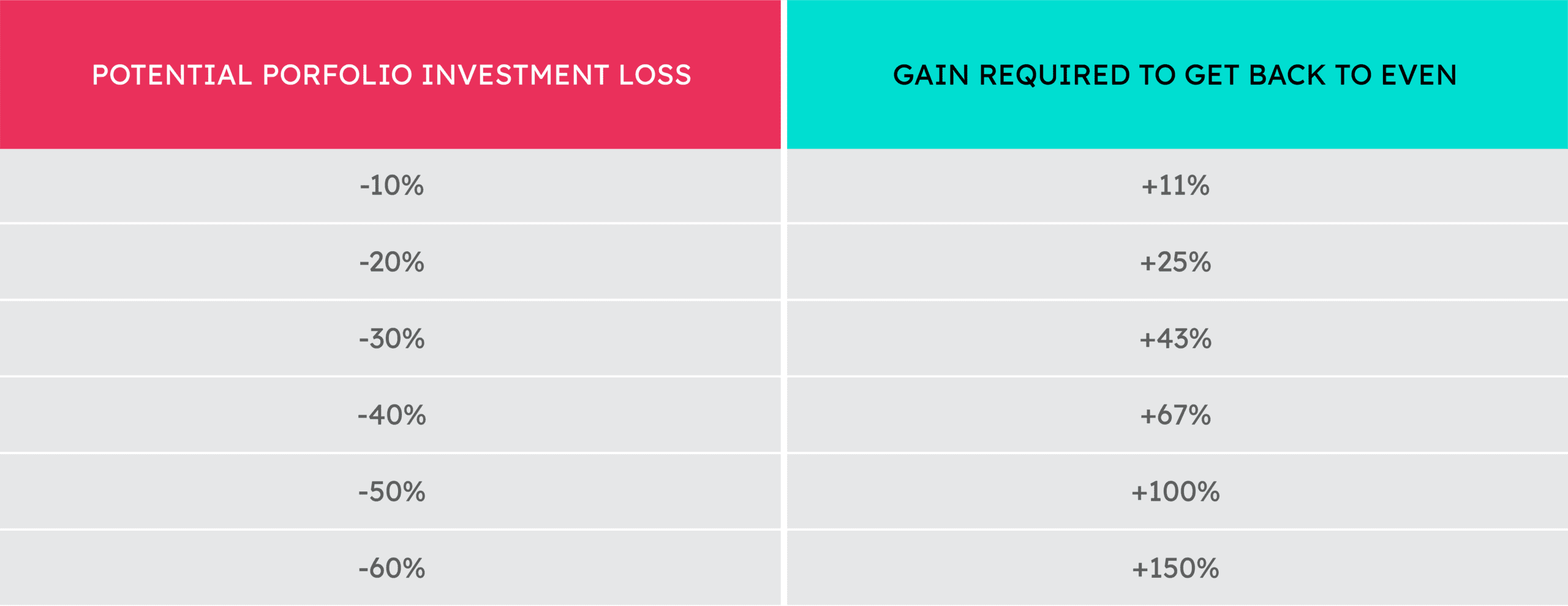
What this table doesn't show is how much time it takes to achieve recovery gains. An analysis by CFRA and S&P Dow Jones Indices shows that for the average bear market since 1945 full recovery took more than two years. But for the three "mega-bears" that occurred during this time (when the S&P 500 dropped 40% or more), full recovery took almost five years.
The COVID Bear Market & Recovery
This brings us to the 2020 bear market and recovery. By all accounts, the COVID bear market was an anomaly. The time to move from peak to trough was only 33 days. That fast decline of nearly 34% was followed by the fastest recovery to new highs on record. From the low on March 23, 2020, the S&P 500 needed only 181 days to make a new high.
Will such rapid declines and recoveries become more normal going forward? Will the fiscal and monetary policy responses become so swift that investors should expect that all bouts of short-term pain will be quickly relieved?
Perhaps more importantly: Will investors abandon their risk management discipline because they believe that bear market losses will be quickly recovered? Did the COVID bear send the wrong message about risk?
Where is the Bear Now?
We did not have to wait long to begin to answer some of these questions? On January 3, 2022, the S&P 500 made a new all-time high. Over the course of the next 282 days, the index shed more than 25% before making a low on October 12th. But was that THE low? It remains to be seen.
If we assume that the October 12th was the low for the 2022 bear market, it's duration from peak to trough was 282 days. Since 1929, the average peak to trough for a bear market has been 341 days and the median duration has been 261 days according to the data from Yardeni Research
Additionally, the 2022 bear market "feels" more like a grind. More like what investors were experiencing in 2008 and early 2009.
There have been three double digit rallies that have given investors hope that the worst of the storm had passed. The first two were followed by new lows for the cycle.
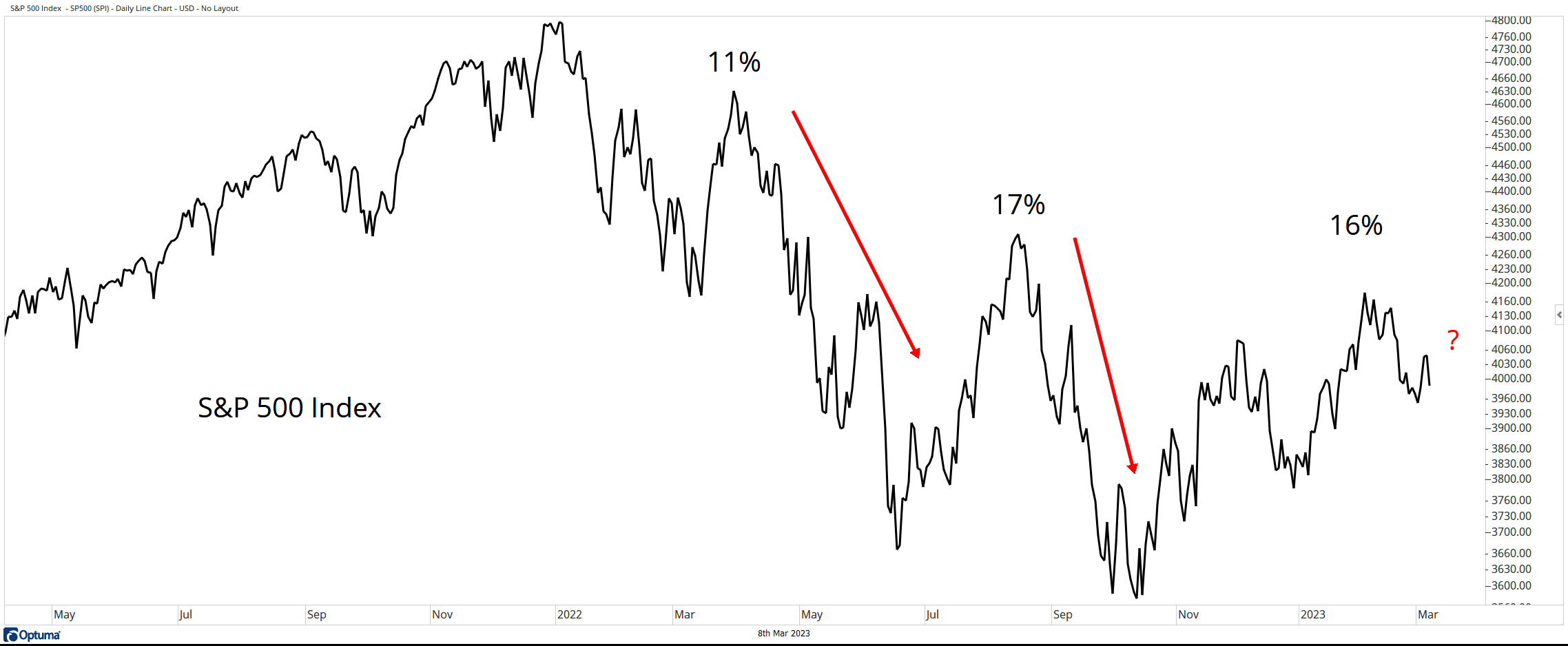
Is the bottom in? We will only know with the benefit of time. But we do know that this bear is not like the COVID bear.
Containing Major Losses is Key
Ideally, investors would want to avoid losses altogether. That would require the foresight to step out of the market at the very peak and re-enter at the very bottom. We don't profess any sort of foresight to allow us to perfectly time market peaks and troughs. Any asset manager who does should be viewed with suspicion. What we seek in our investment strategies is to avoid catastrophic losses that require a significant amount of time for recovery.
Market returns can be lost more easily than they can be gained. So, the key to successful investing over the long term is to contain major losses that take too much time or too much exposure to volatility to recover from.
It's how we developed our philosophy, "win, by losing less."
(PFM-607-2023032)
Potomac Fund Management (“Potomac”) is an SEC‑registered investment adviser located in Bethesda, Maryland. Registration does not imply a certain level of skill or training, nor is it an endorsement by the SEC. This material is for general informational purposes only and does not constitute investment advice, tax advice, or a recommendation regarding any specific product, security, strategy, or investment decision. Readers should not assume that any discussion or information applies to their individual circumstances. This communication does not constitute an offer to buy or sell any security or a solicitation to provide personalized investment advice for compensation. Nothing herein should be construed as individualized or tailored advice delivered over the internet.
Opinions expressed are current as of the date of publication and may change without notice. Information obtained from third‑party sources is believed to be reliable, but Potomac does not guarantee its accuracy or completeness and is not responsible for any third‑party content referenced or linked in this material.
Investing involves risk, including the possible loss of principal. Past performance does not guarantee future results. For additional important disclosures, please visit potomac.com/disclosures.
Explore our latest insights, watch the “Who Are You?” series.

potomac presents