Last month, we discussed the third year of the Presidential Cycle, and 2023 was playing out as a perfectly normal year from a seasonal perspective. As we move into November, that remains the case. The market has continued to be choppy, frustrating both the bulls and the bears. Recall that the seasonal pattern calls for this into November before giving way to a year-end rally...ON AVERAGE.
We also noted that for this month, we would answer the natural next question: what does the fourth year of the cycle look like, i.e., the Election Year? Since 1952, there have been 18 election years. Fifteen of them have been positive. The three that were lower were 1960, 2000, and 2008, with that last one proving to be a massive downside outlier.
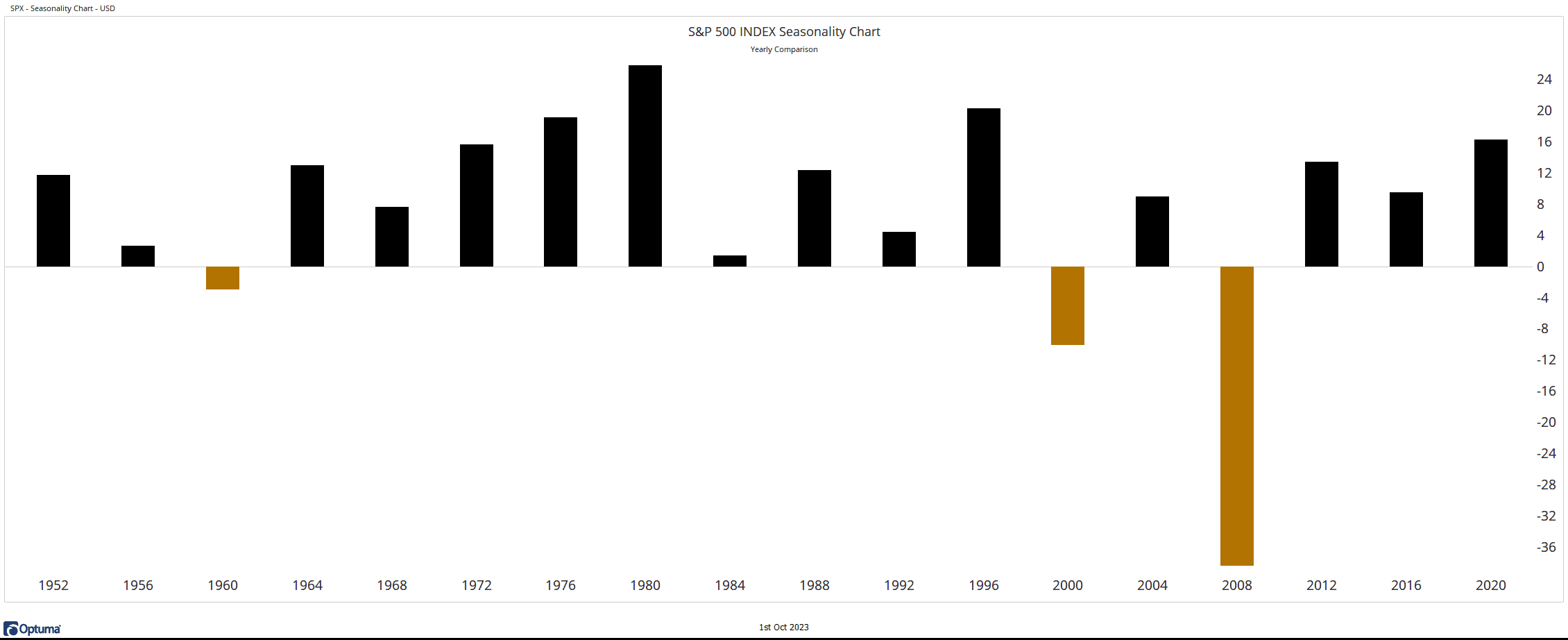
Once again, I want to reiterate that we hate charts and graphs like this. While they are somewhat interesting on the surface, they do not give the investor any indication of what the ride is like. For instance, the mean return during an election year is 7.40% and the median return is 9.89%. Clearly 2008 had a big impact on the mean. However, we have no sense of what we must endure to arrive at those returns. Should you simply hold on tight in 2008 because the election years tend to be positive? I would argue no, but I am a tactical manager. The buy and hold acolytes would argue that you should just hold on, time in the market is their mantra.
As it turns out, the first two and a half months of an election year can be a bit bumpy. On average, the S&P 500 makes a bottom near day 50 (mid-March) before moving steadily higher for the remainder of the year.
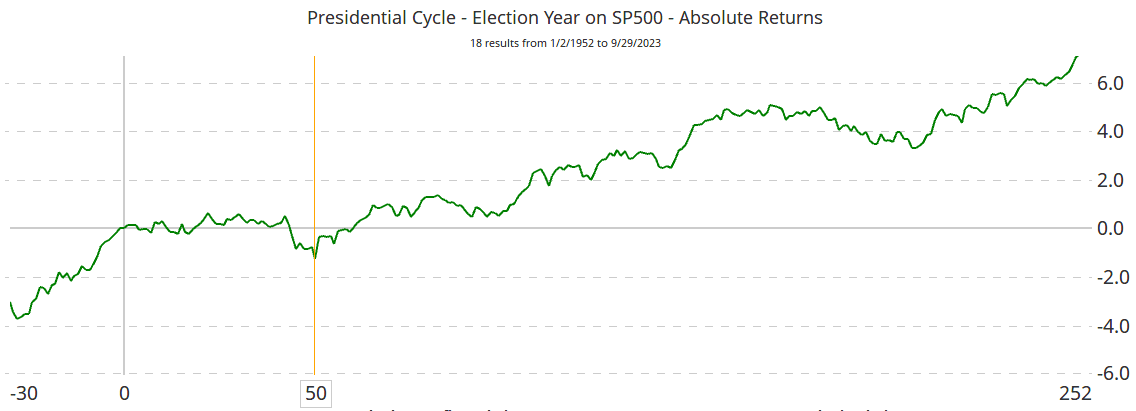
The problem is we still have not found that magical crystal ball that allows us to look into the future to see if, on day 50, the year will play out as the average dictates or if there will be another 2008. Do you really want to roll the dice here?
A Tactical Approach to Seasonality
While we like to pay attention to the seasonal trends, our focus on systematic investing and risk management (especially metrics such as maximum drawdown) precludes us from blindly adopting a buy-and-hold approach to markets.
However, we are open to the fact that there are seasonal anomalies that tend to repeat. In fact, in our process, there are two that we focus on. One is focused on trading around the end of month while the other identifies opportunities around specific holidays in the United States.
For the month-end strategy, we do not simply apply it to all months; there are other seasonal factors that come into play. For instance, the month-end signals do not fire in the summer. Astute readers will recognize that this is due to the fact that the summer months tend to be less strong. Think of it as the Potomac take on "sell in May and go away." You don't think that we just go to cash on May 1st and reinvest on November 1st, do you?
As for the holiday trades, we have identified certain holidays in the United States that provide opportunities for tactical short-term trading such as Easter, Thanksgiving, and Christmas. There is also one around Halloween that I would be remiss for leaving out as I sit and write on October 20th.
A Nice to Have
As we noted last month, seasonal factors are a "nice to have." They are what I like to call an upside kicker. They can, however, take a back seat to the three main pillars of technical systematic investing.
What is the trend?
Is the trend healthy (breadth)?
Is the trend confirmed by other markets (intermarket analysis)?
If the answers to these questions are Bullish, yes, and yes, the seasonality is a nice added upside kicker. However, if the trend is bearish and confirmed by breadth and momentum, then seasonals may not play out as the averages dictate.
Price remains the most important indicator.
PFM-619-20231101