If I told you that in the third quarter of 2024, a presidential election year, the Republican nominee for the White House had not one but two attempts on his life, how would you expect the U.S. equity market to respond?
If I told you that in the third quarter of 2024, a presidential election year, the Democratic nominee for the White House had withdrawn from the race and his Vice President had assumed his position as the new nominee, how would you expect the U.S. equity market to respond?
If I told you that hostilities were intensifying in the Middle East and appeared to be expanding in geographic scope, how would you expect the U.S. equity market to respond?
These are just three scenarios that played out during the third quarter of 2024. There are others, but these will help make a point. Investors are taught-conditioned, even-to believe that the stock market hates uncertainty. Perhaps this isn't fair, because nothing is ever truly certain in this world. Let's just say that the stock market, we are told, hates it when the number of possible outcomes from an event increase while it becomes harder to assess the likelihood of each outcome.
I would argue that the three events described above, on their own, fit the bill for something the market should hate-let alone all three occurring within the same three-month period of a calendar year.
Throw in the fact that since 1950, August has been a relatively flat month for the S&P 500, and September has historically been a negative month on average.
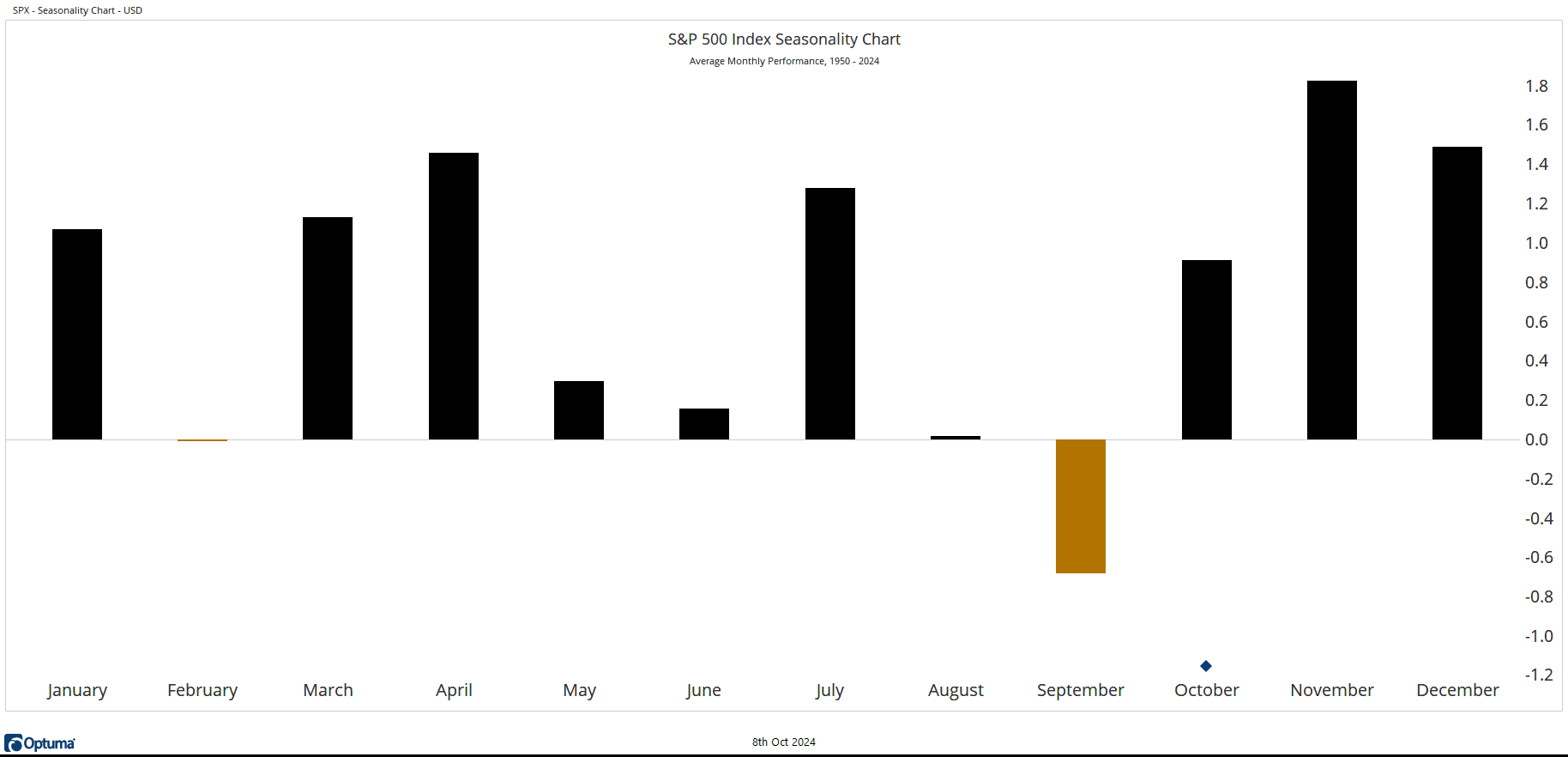
Source: Optuma
I wouldn't hold it against you if you told me that, given all the above, the S&P 500 would have had a disastrous quarter. Given my own predisposition, I might have predicted an epic crash. I could even have made a strong case for planning or positioning for a large drawdown. And we would have been wrong.
The S&P 500 closed the quarter near an all-time high. This is not a typo. In the face of ever-increasing uncertainty, the index-against which most investors measure their performance-is trading near record highs. Keep in mind that these record levels were achieved despite the market giving us a nearly 8.5% drop (on a closing price basis) during the quarter.
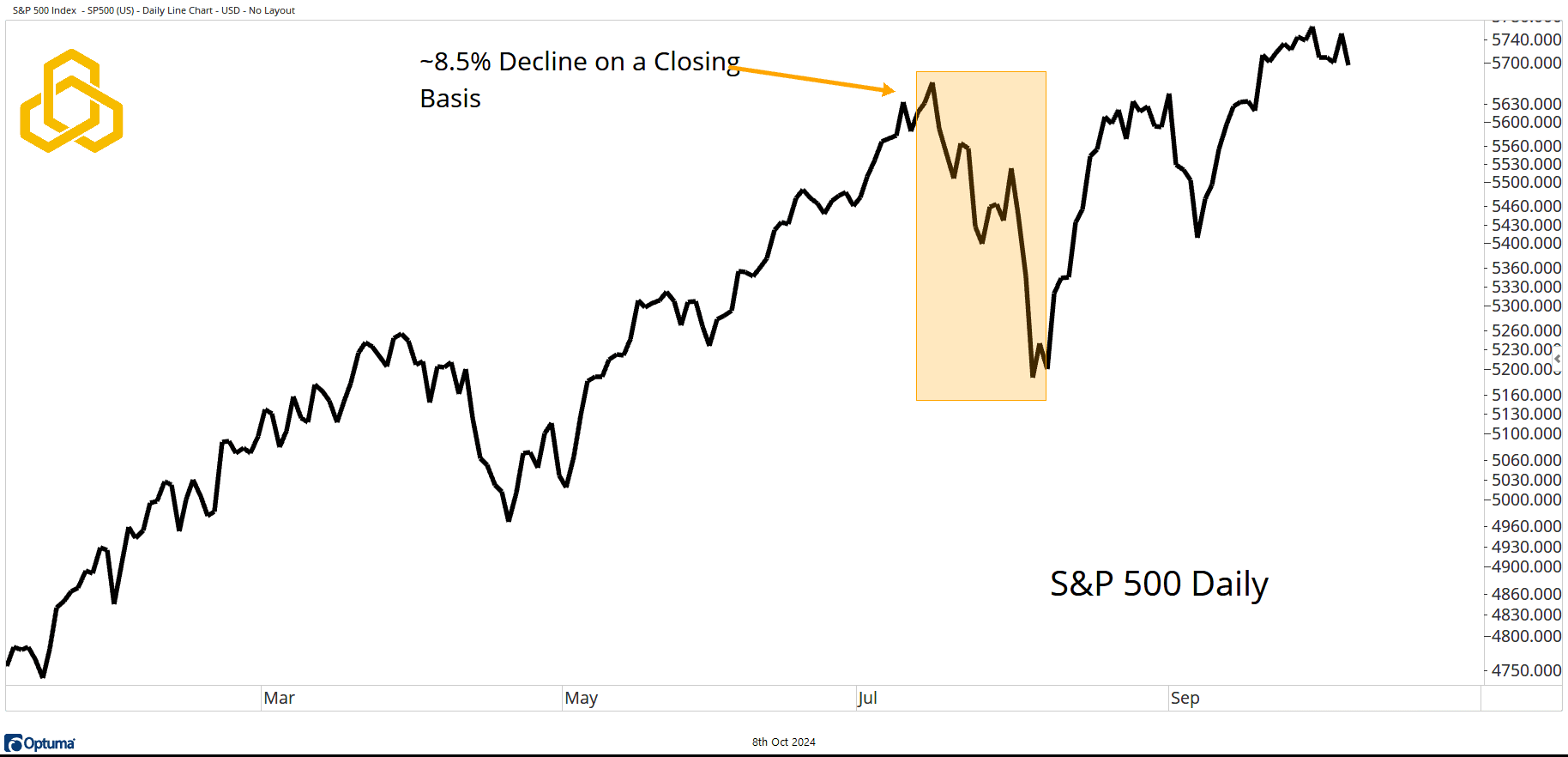
Source: Optuma
But what do stock investors know anyway? All my career, I've heard that stock investors are the "dumb money," and that the bond market is where the "smart money" resides. Surely, the bond market would have been adept at reacting to and repricing for the elevated levels of uncertainty in the world, right?
Wrong again. The iShares iBoxx High Yield Corporate Bond Fund (HYG) also ended the quarter near record levels on a total return basis.
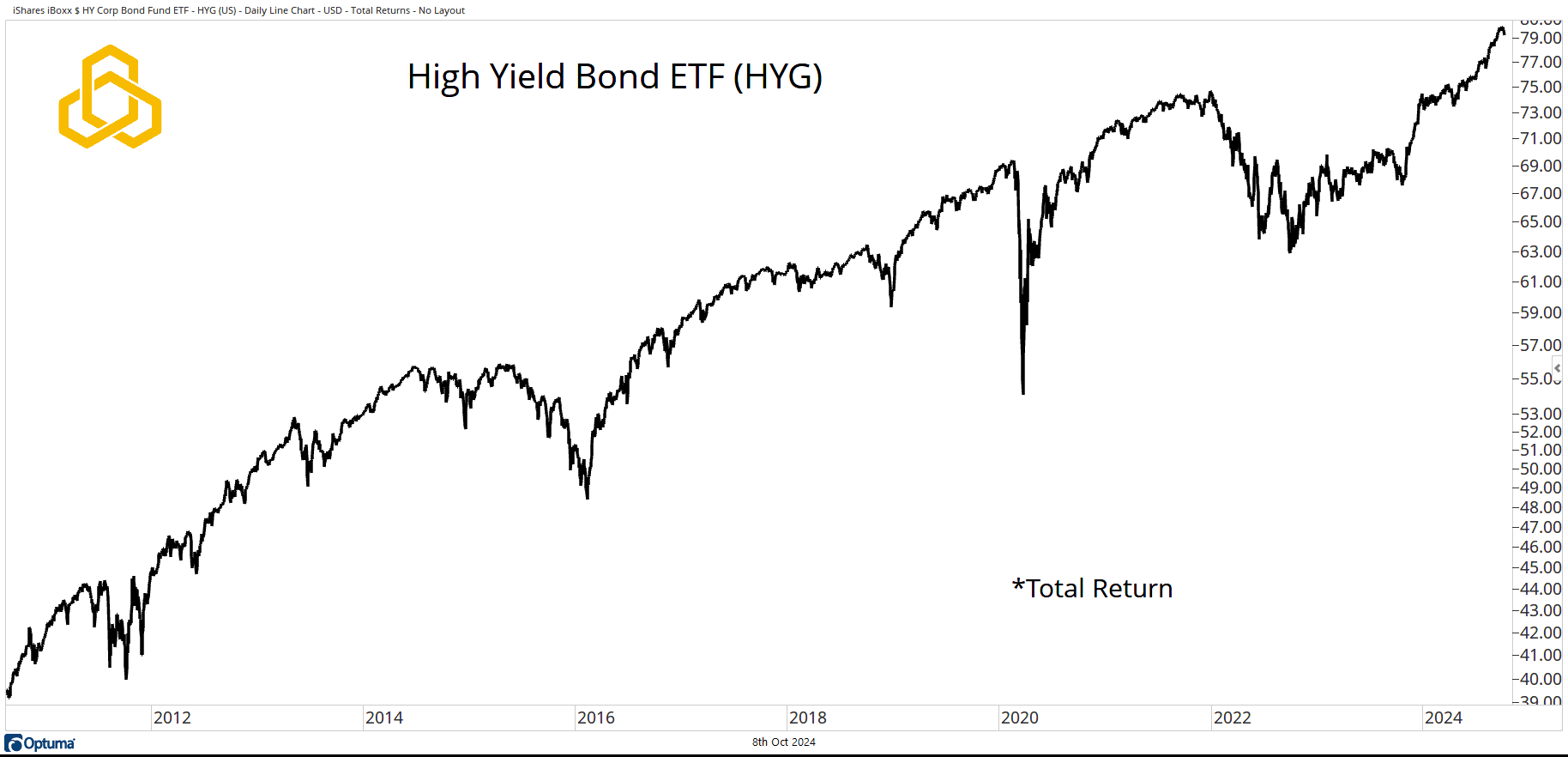
Source: Optuma
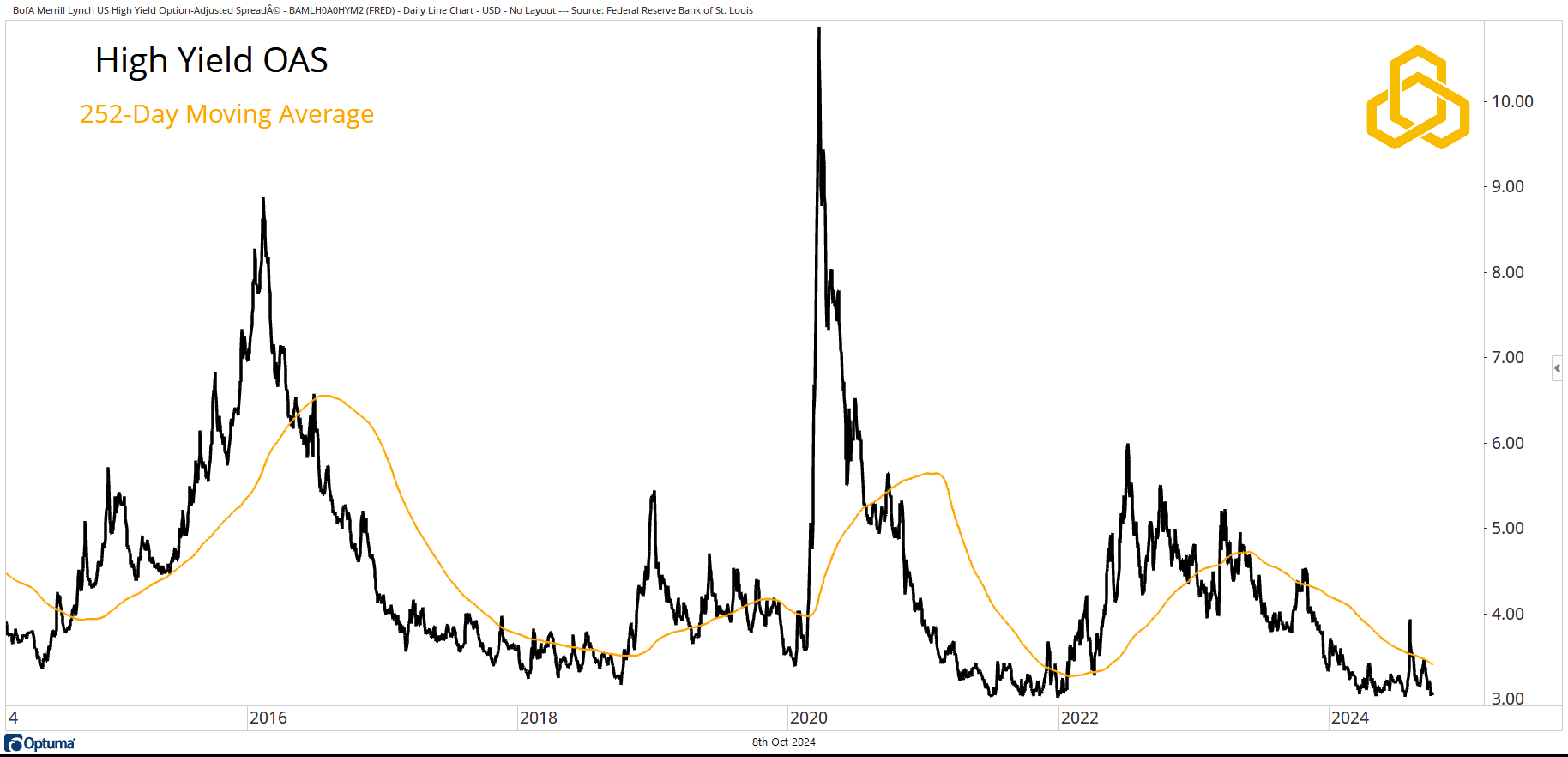
Yeah, but that's just an ETF. Smart money trades the actual credits, right? Well, the High Yield Option-Adjusted Spread (OAS)-the difference between high yield rates and Treasury rates-is trading near ten-year lows, below its declining one-year moving average.
Source: Optuma
The simple fact of the matter is that no one-not me, not you, no one-can predict what "the market" will choose to care about. We can assess the situation and plan, but a riff on a famous quote comes to mind: "We plan, the market laughs."
Once again, we are taught the lesson that trying to predict what will happen in the market is a fool's game. Building an elaborate narrative or thesis will likely do nothing more than lock you into a point of view that you'll feel obliged to defend. Isn't it better to systematically calculate the odds using an objective process than to hope the market agrees with your view?
*All price charts from Optuma as of the close of trading on October 8, 2024
PFM-361-20241008