
Since the early beginnings of capital markets, investors have been drawn to buying assets that have decreased in value in the hopes that "what goes down, must come up." While this statement can be true, particularly over very long-time horizons, many investors often fail to ask the more appropriate question; "What is the risk of buying an asset that has materially deteriorated in value?"
In this blog post, we seek to provide some historical context around "dip buying" opportunities and, more importantly, the risks associated with such a strategy.
Investors who have been successful in buying stocks that have declined in value are less likely to change their strategy than those who have been successful in following trends or buying breakouts. In fact, many investors prefer certain strategies because they simply work well for them.
Before we dive too deeply into testing and historical results, it's important to note that the work presented here will not solve the debate amongst investors who buy stocks that have materially declined in value vs. those who follow trends. This work primarily provides historical context and potentially shines a new light on what has happened vs. what we think "should" happen when a stock declines over time.
First, we need to spend some time defining what a "dip" is in security before we can implement any testing around the idea. For this post, we'll look at new lows for the S&P 500 index over one month (21 trading days) and view both risks and return over the subsequent quarter after these events occur.
Additionally, a trend filter will be applied for closing above and below the 200-day moving average, a common measure of a long-term trend.
While long-term data should always be taken into consideration, it's important to note that many stocks tend to move with the market and trend upwards over time. As mentioned before, the market's tendency to trend over time can often hide the risks associated with any strategy tested over a long timeframe.
While there are many methods designed to detrend data, we prefer to stick to the simplest: testing from March 2000-March 2013, a period with two major shocks where the index ended very close to where it started.
One-Month Lows
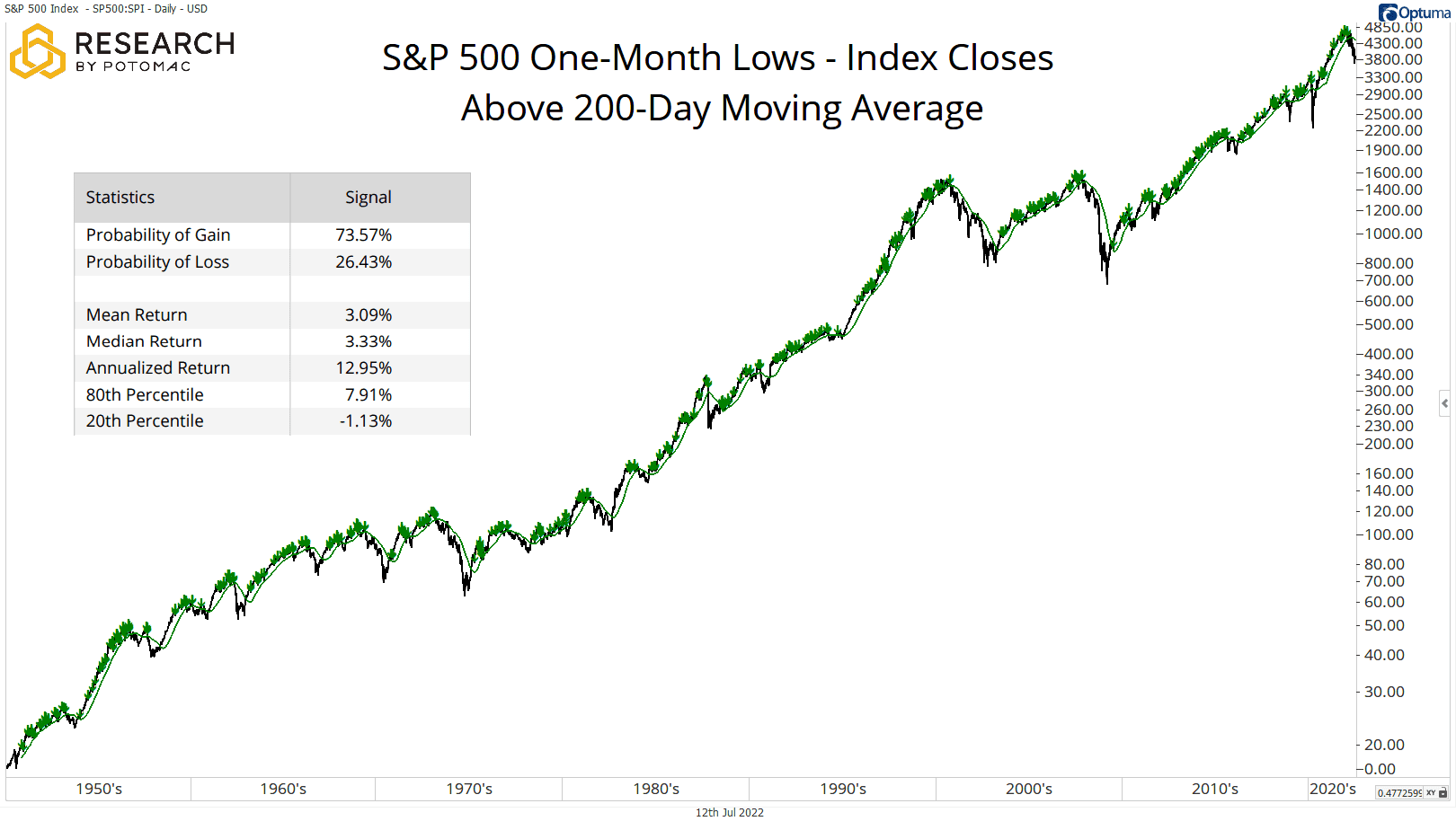
There were 734 instances since 1950 where the S&P 500 made a new one-month low while closing above the 200-day moving average for a median gain of 3.33% with a 73.57%-win rate over the following quarter, with 20th percentile losses coming in at -1.13%.
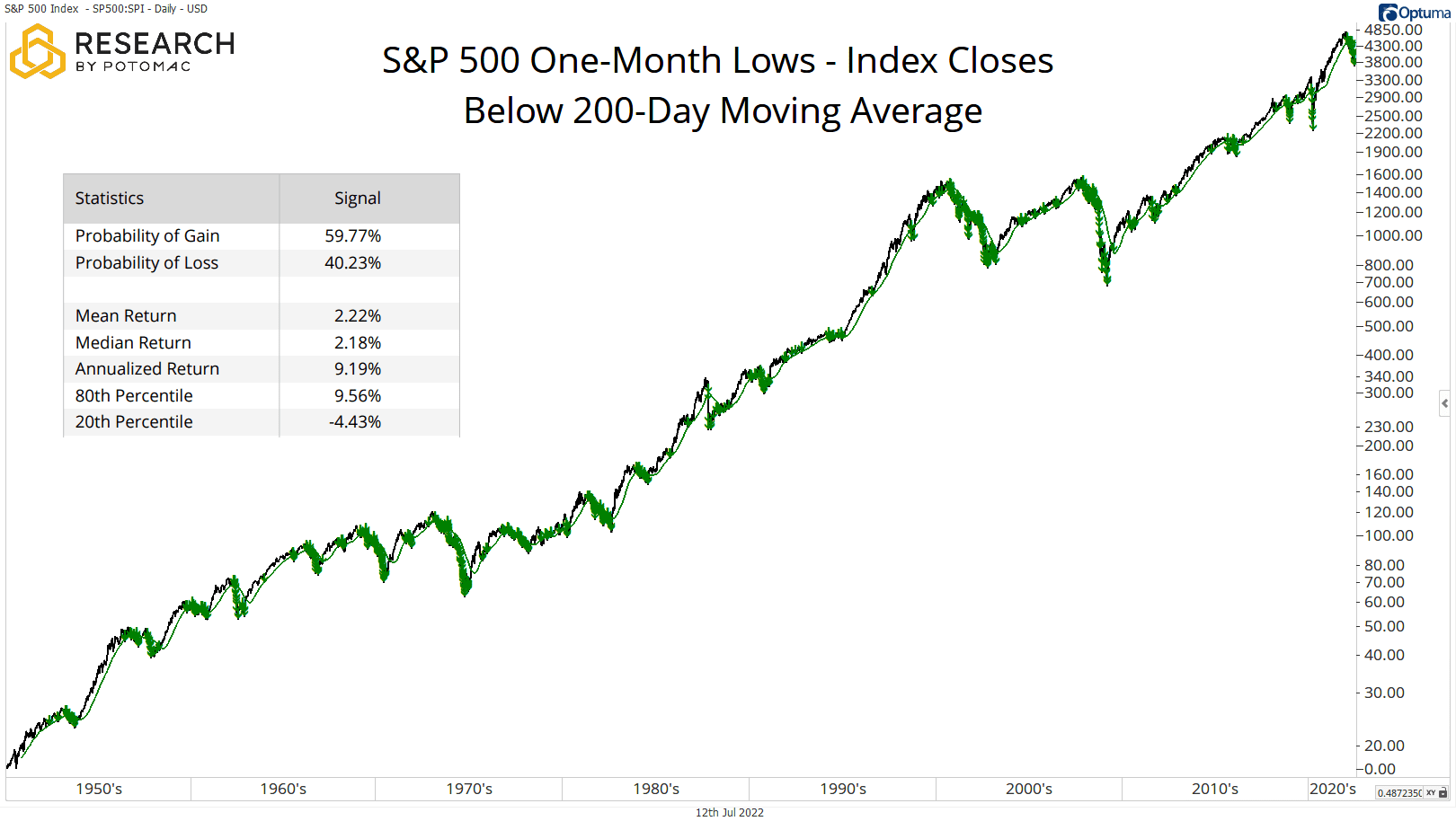
There were 977 instances since 1952 where the S&P 500 made a new "one-month low" while closing below the 200-day moving average for a median gain of 2.18% with a 59.77%-win rate over the following quarter, with 20th percentile losses coming in at -4.43%.
One-Month Lows March 31, 2000 - March 31, 2013
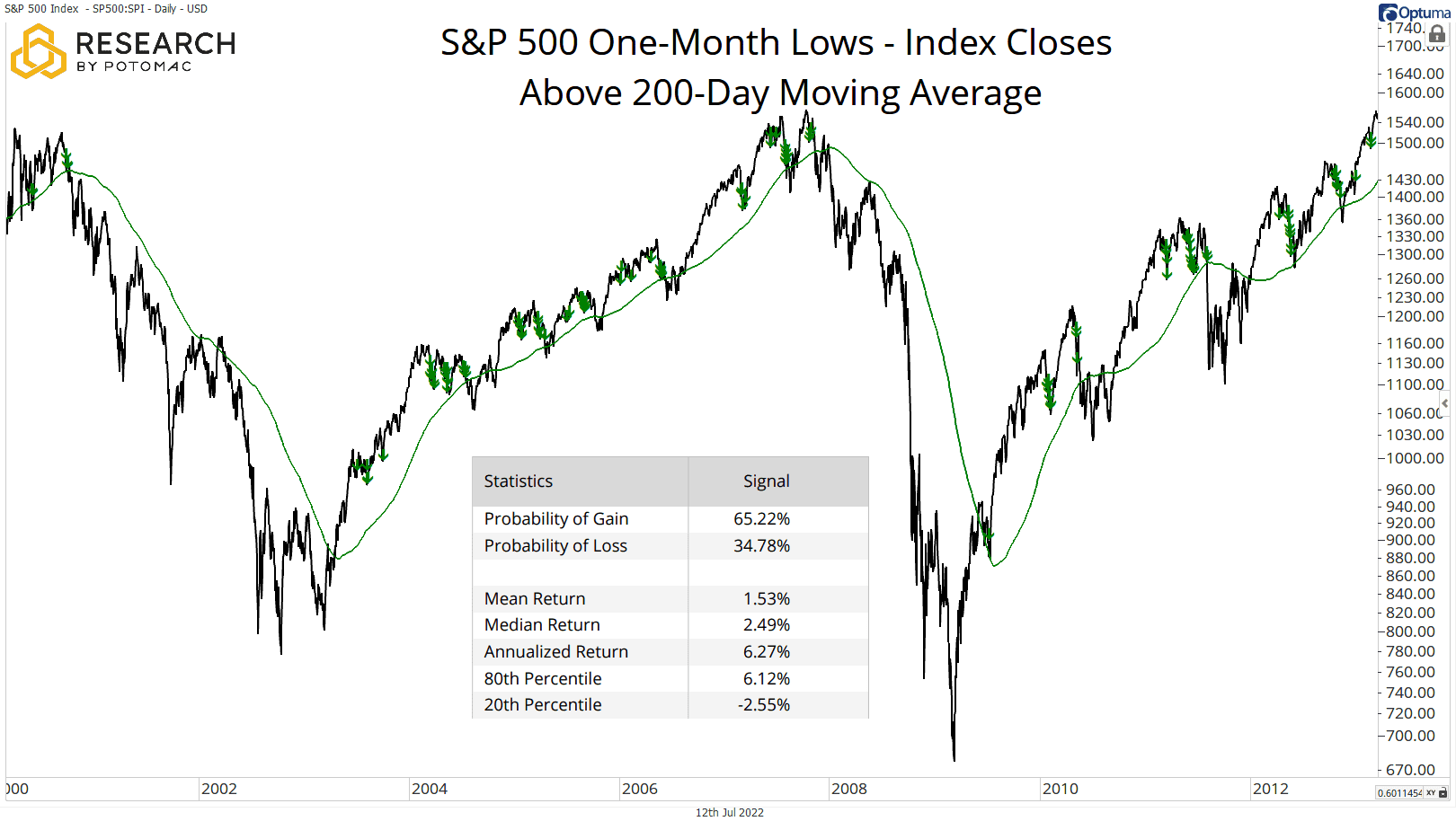
There were 118 instances from March 31, 2000 - March 31, 2013, where the S&P 500 made a new one-month low and closed above its 200-day moving average for a median gain of 2.49% with a 65.22%-win rate over the following quarter, with the 20th percentile losses coming in at -2.55% over this time period.
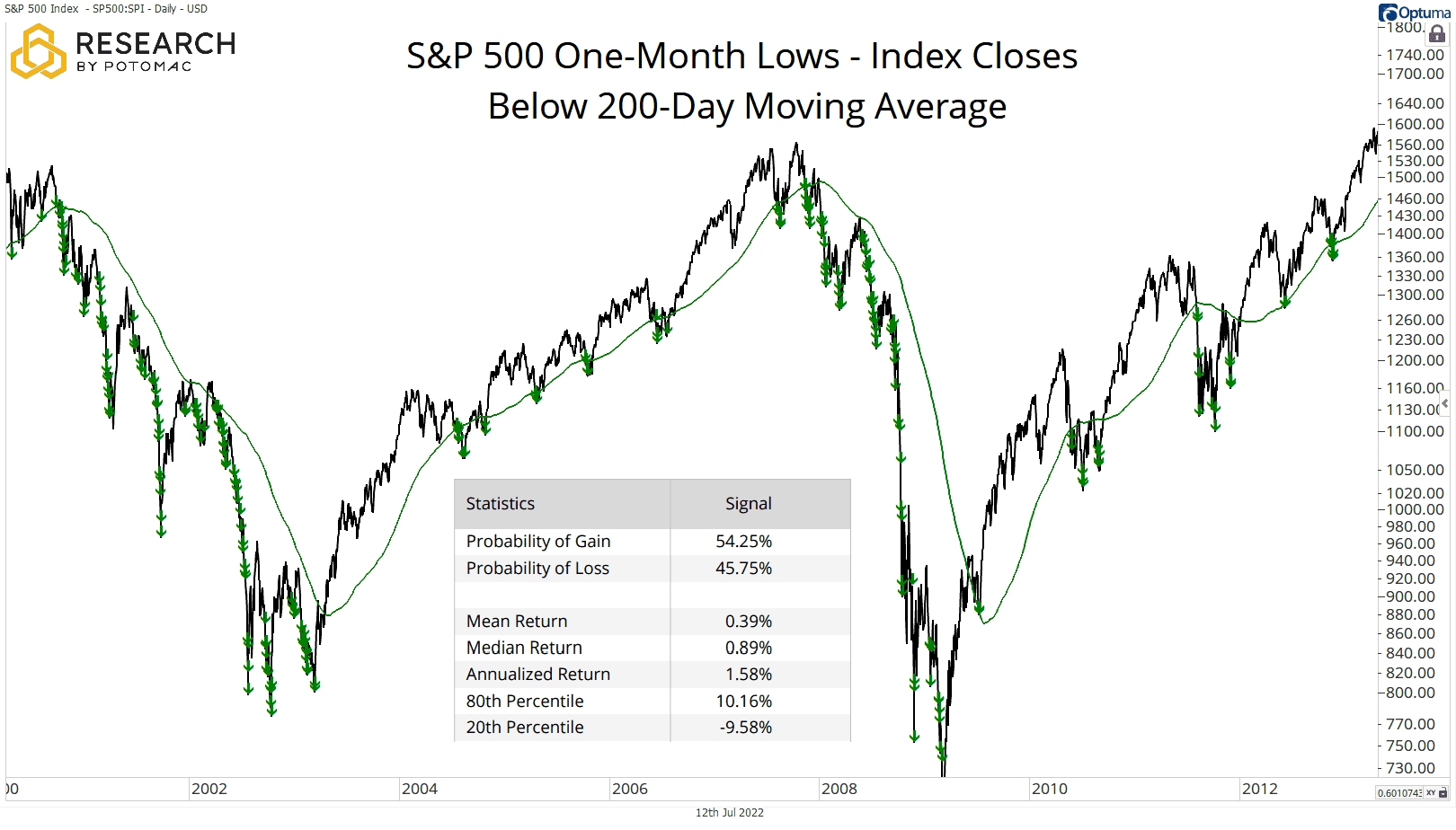
There were 247 instances from March 31, 2000 - March 31, 2013, where the S&P 500 made a new one-month low and closed below its 200-day moving average for a median gain of 89bps with a 54.25%-win rate over the following quarter, with 20th percentile losses coming in at -9.58%.
Final Thoughts
Many investors operate on the premise that "what goes down must come up" when it comes to capital markets, and the reality is that this phrase is only partially true. The important point that many long-term investors overlook is the issue of context-is the market trending up or down? Is it a period of heightened volatility? And more importantly, what exactly constitutes a "dip"?
Note that in the results above, both median gains and win rates have historically been better when entering the market on a new one-month low when it closes above its 200-day moving average vs. closing below.
Additionally, 20th percentile losses have historically been deeper when the index closes below its 200-day moving average vs. closing above following a new one-month low. Essentially, there is a higher level of risk when the index is below the 200-day moving average.
We concede the point that one-month lows are by no means the definition of a "dip" in market price action. In fact, there is a multitude of methods that can be utilized to measure such an event. However, in practice, we have observed many investors applying the term "dip" in both a subjective manner and without context to the long-term trend.
While the rules applied in this body of work might appear to be semantics to meet the criteria of objective testing, they also can serve as an example that investors can take and apply to their own methodology of investing.
Subjectivity in capital markets tends to be the enemy of consistency, and having a system in place for investors whose style is geared toward purchasing assets that have materially declined in value can serve as a form of risk management and capital preservation to avoid deep losses.