During the pandemic, high-frequency data was all the rage as investors desperately searched for clues about how many consumers were starting to fly, dine, and drive again. With the Strait of Hormuz reopening, we thought it was worth revisiting high-frequency data to see what it is telling us today. Below, we share the six charts we find most interesting.
Figure 1. Strait of Hormuz Tanker Vessel Daily Crossings

Sources: Bloomberg L.P., and Potomac. Data as of June 29, 2026
Takeaway: It should come as no surprise that this is our most interesting chart. While vessel traffic has yet to return to pre-war levels, it is encouraging to see crossings gradually recover in the Strait of Hormuz.
Although traffic has eased again following a drone strike on a Singapore-flagged cargo ship and U.S. strikes on Iranian targets, investors appear to be looking beyond the conflict, with commodity prices falling sharply over the past month.
Figure 2. West Texas Intermediate Crude Oil Prices ($/BBL)

Sources: New York Mercantile Exchange, Bloomberg L.P., and Potomac. Data as of June 29, 2026.
Takeaway: The fading geopolitical risk premium can be seen clearly in oil prices, with West Texas Intermediate crude down roughly 39% from its record daily close of $112.95 per barrel on April 7, 2026. Retail gasoline prices have also declined, falling from a national average of $4.56 to $3.86 per gallon, a drop of $0.70, since late May.
We expect gasoline prices to decline a bit further in the coming weeks, as retail prices typically lag crude oil by about one week. If sustained, this could lower headline inflation by roughly 0.4 percentage point year over year in June and serve as a positive psychological catalyst should headline CPI fall back below 4%.
Figure 3. 2-Year U.S. Treasury Yield vs. the Fed Funds Rate (%)

Sources: Department of Treasury, Federal Reserve Board of Governors, Bloomberg L.P., and Potomac. Data as of June 29, 2026.
Takeaway: The two-year U.S. Treasury yield is often viewed as the market's leading indicator for Federal Reserve policy, typically rising ahead of rate hikes and falling before rate cuts.
Even though oil prices have declined sharply over the past month, the two-year yield has not. This suggests that while the commodity shock may be fading, the rate shock may just be beginning, with the bond market pricing in at least one additional rate hike by year-end, possibly as soon as September.
In other words, geopolitical uncertainty may be easing, but monetary policy uncertainty is on the rise.
Figure 4. NASDAQ-100 Volatility Index Relative to the S&P 500 Volatility Index
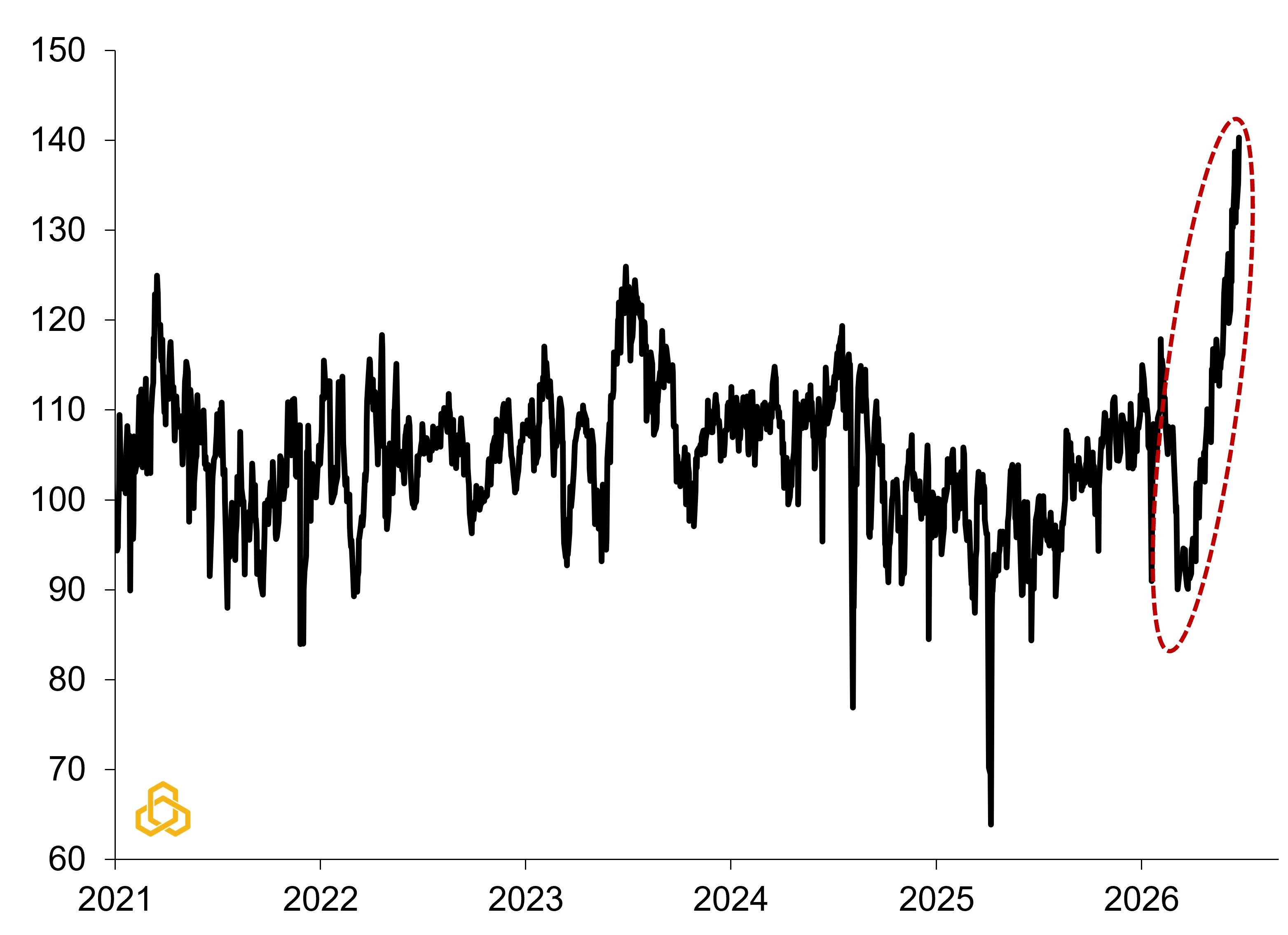
Sources: Chicago Board of Exchange, Bloomberg L.P., and Potomac. Data as of June 29, 2026. Note: This time series is the NASDAQ 100 VXN volatility index over the S&P 500 VIX volatility index with each rebased so that January 1, 2021 = 100.
Takeaway: Rising monetary policy uncertainty has spilled over into financial markets, with technology stocks experiencing significantly more volatility than the broader S&P 500. There are several reasons for this, including rich valuations, growing uncertainty surrounding the cost of the AI buildout, and rising bond yields.
Technology stocks are long-duration assets, meaning much of their expected earnings lies far in the future. As real yields rise, the discount rate used to value those future cash flows increases, reducing their present value. Higher real yields also make risk-free alternatives more attractive. For example, a two-year Treasury yielding 4.2% becomes a much stronger competitor for investor capital.
Combined, these headwinds have pushed the NASDAQ down roughly 5% in June.
Figure 5. DRAM Memory Spot Price (DDR5 1Gx16)

Sources: Inspectrum Tech, Bloomberg L.P., and Potomac. Data as of June 29, 2026.
Takeaway: In 2006, British mathematician Clive Humby famously remarked, "Data is the new oil. It's valuable, but if unrefined it cannot really be used." Two decades later, that analogy has taken on new meaning. If data is the new oil, then AI data centers are the refineries that transform it into economic value. As companies race to build AI infrastructure, demand for memory chips has surged, driving DRAM prices sharply higher.
Just last week, Apple cited soaring memory and storage chip costs as it raised the price of the MacBook Air by $200 and the iPad Air by $150, providing one of the clearest examples to date of AI-related cost pressures reaching consumers.
That said, investors should be careful not to overstate the inflationary implications.
While AI-driven demand is likely to boost margins for memory manufacturers such as Micron and pressure margins at hardware companies like Apple unless those higher costs are passed on to consumers, computers and related accessories account for less than 0.3% of the CPI basket. As a result, even a 30% increase in prices would add only about 0.1 percentage point to headline inflation, making this a much bigger story for corporate earnings than for inflation.
Figure 6. Johnson Redbook Weekly Same-Store Sales (YoY%)

Sources: Redbook Research, Inc., Bloomberg L.P., and Potomac. Data as of June 20, 2026. Note 1: The Johnson Redbook Index covers a sample of large U.S. general merchandise retailers representing about 9,000 stores. Redbook does not collect data from online retailers in compiling the index. Note 2: Shaded regions denote periods of U.S. recession.
Takeaway: If there is one chart that should reassure investors, it is this one. Weekly Johnson Redbook retail sales are currently tracking around 10% year over year, one of the strongest readings outside of the post-pandemic reopening surge in 2021. Because gasoline prices have been falling, the recent strength is unlikely to be driven by higher fuel costs alone, suggesting retail demand has remained more resilient than many investors expected. One theory worth watching is whether lower gasoline prices free up income that consumers ultimately spend elsewhere, helping support economic growth while also slowing the decline in underlying inflation.
Conclusion: Markets are constantly bombarded with headlines, making it easy to lose sight of what is changing beneath the surface. This week, the data suggest geopolitical risks are fading, energy prices are moving lower, and the bond market remains focused on inflation and monetary policy. At the same time, the AI investment boom is creating winners and losers across industries without materially changing the broader inflation outlook, while resilient retail spending suggests the consumer remains on solid footing. If lower energy prices ultimately encourage households to redirect spending toward other goods and services, the decline in headline inflation may not translate into an equally rapid easing in underlying inflationary pressures. As always, we believe the best investment decisions are made by focusing less on the headlines and more on the data.
Weekly “Keeping it Strait” Highlights:
Economic surprise indices across the United States, Europe, and China each improved this week. We doubt this is reflecting lower oil prices yet, but it is encouraging to see better data across multiple regions. Inflation data in the Eurozone showed an easing in June to 2.8% from 3.2% the month prior. We could see a similar move in the United States in mid-July.
Atlanta Fed’s GDPNowcast was revised down from 3.1% to 2.5% on the back of more moderate durable goods orders. Both Fed trackers are now centered around growth of about 2.5% in the second quarter of 2026.
Crude oil volatility has come down significantly with the OVX falling to 43.17. The last time the gauge was this low was on February 17, 2026 – before the war.


