
Why Advisors Should Rethink the “Missing Days” Narrative
Whenever the S&P 500 declines by 10 percent or more, a familiar chart begins circulating. It shows how long‑term returns are devastated if an investor misses just a handful of the market’s best days. The message is meant to be clear and comforting: stay invested at all costs.
While this argument resonates with buy‑and‑hold advocates, it rests on a simplified story that ignores how markets actually behave during periods of stress. The reality is more nuanced and far more relevant to how real investors experience risk.
The Problem With “Missing the Best Days” Charts
It is undeniably true that missing only the best days in the market would destroy long‑term returns. That point is well documented and not in dispute.
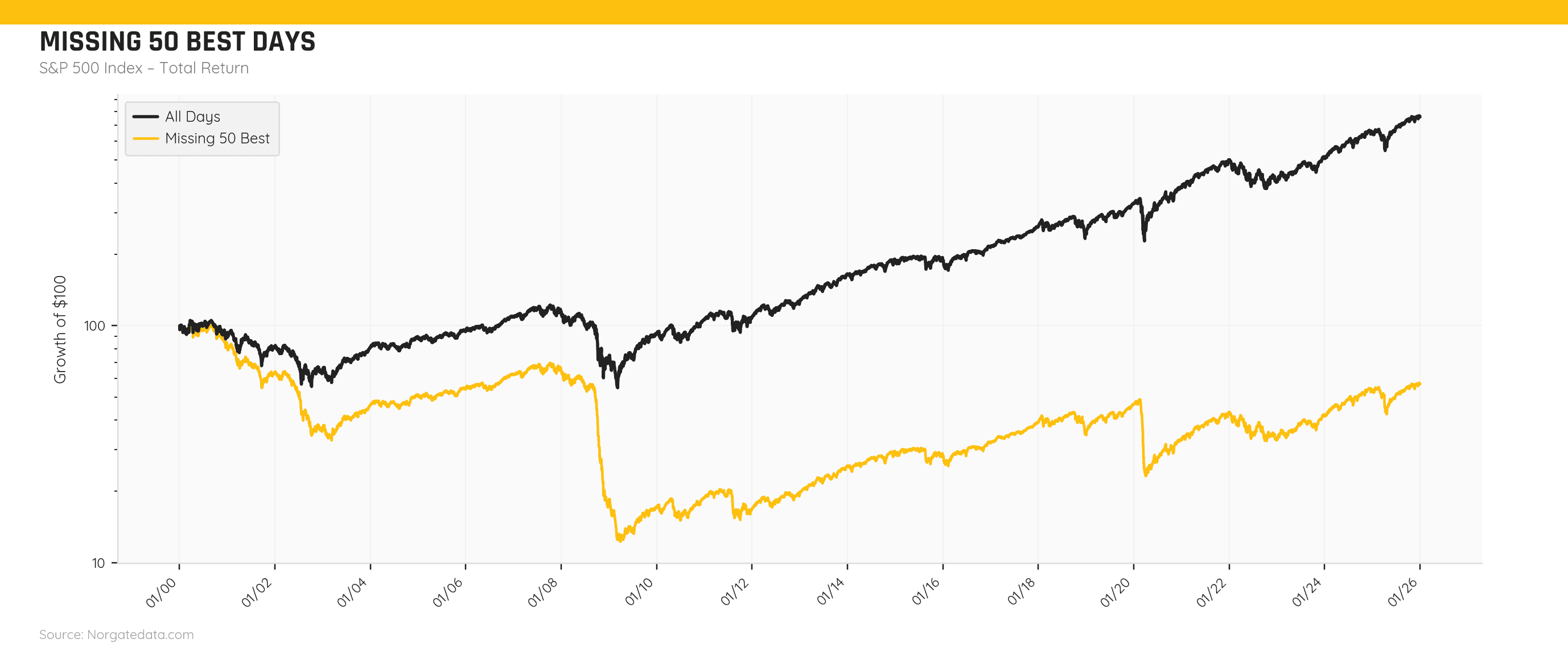
Source: Norgate Data
The issue is where those best days tend to occur.
The strongest up days in the market most often happen during bear markets, which are the same environments that produce the worst days. Periods of extreme volatility cluster outsized gains and losses together. Focusing solely on the upside without acknowledging the accompanying downside presents an incomplete picture of investor reality.
Advisors who follow a buy-and-hold approach are forced to endure the full drawdown of these periods and then rely on market rebounds to recover losses and retain clients. The “missing days” argument becomes a defense mechanism during bear markets rather than a holistic assessment of risk.
What Happens When You Look at the Worst Days, Too
When the analysis is expanded to consider the inverse experience of avoiding the worst days, a dramatically different outcome emerges.
Avoiding the fifty worst days in the S&P 500 from 2000 through 2025 significantly improves results compared to buy and hold. This finding highlights how deeply damaging large down days are to long‑term compounding.
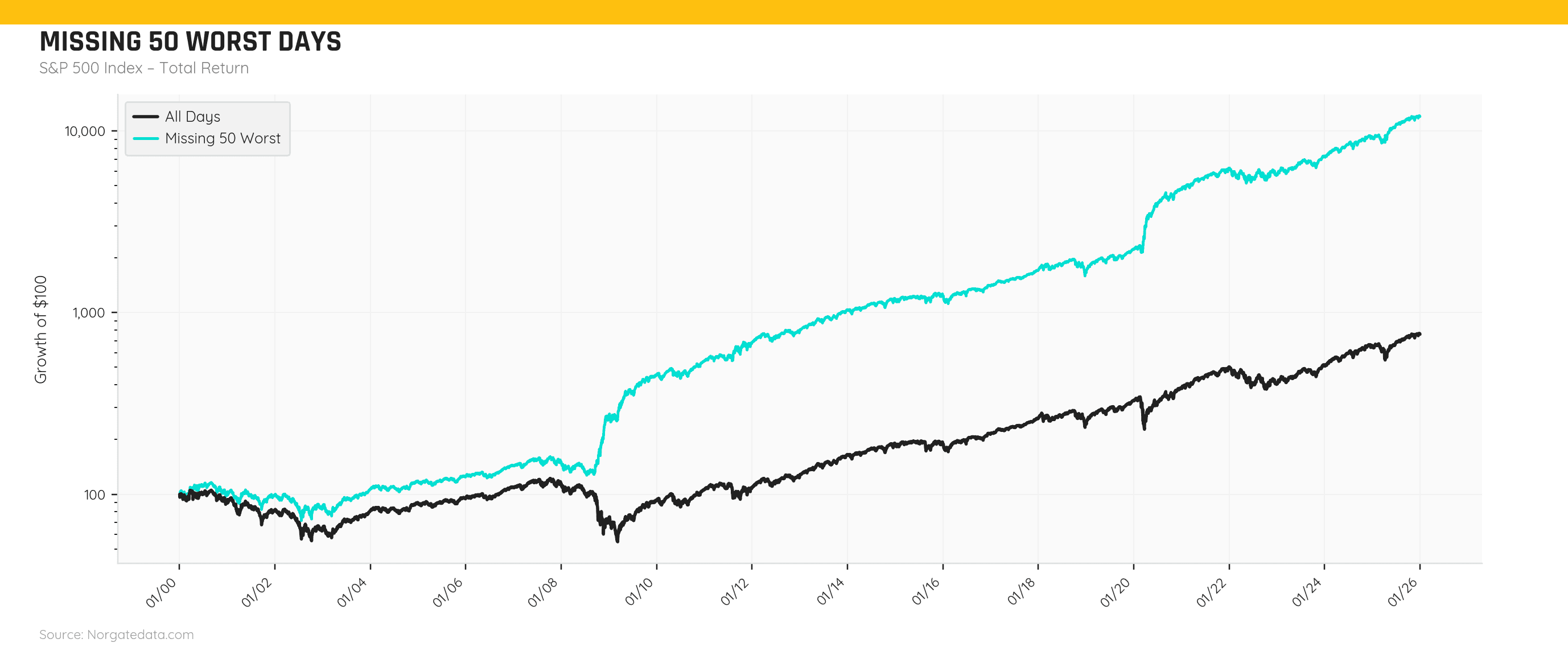
Source: Norgate Data
The common rebuttal is that no one can reliably identify the worst days in advance. That criticism is valid. But stopping the analysis there misses an important question. What happens if an investor avoids a combination of both extremes?
Missing Both the Best and Worst Days
When both the best and worst days are removed together, the results challenge one of the industry’s most persistent assumptions.
An investor who missed both the fifty best and the fifty worst days over the same period would have outperformed a buy‑and‑hold approach. This directly refutes the idea that success depends entirely on remaining fully invested to capture every major rally.
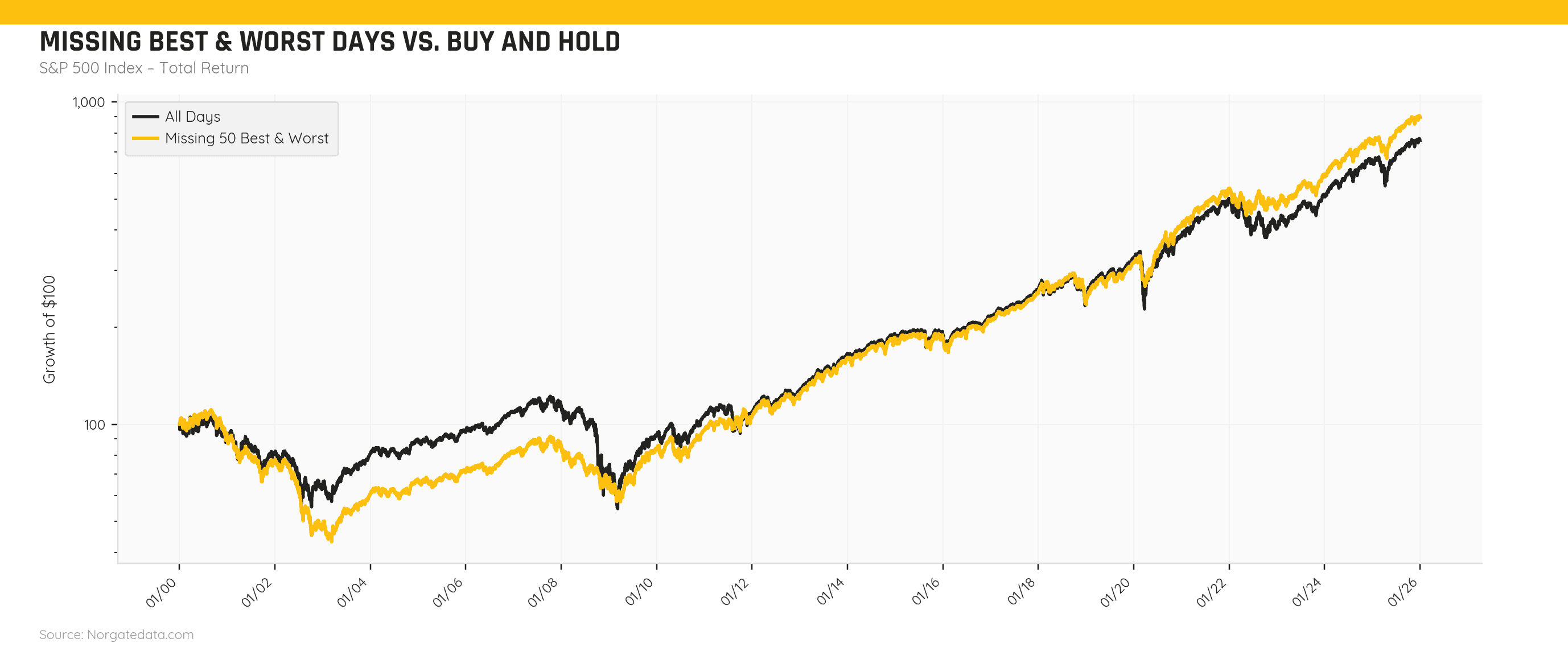
Source: Norgate Data
The takeaway is straightforward.
· Missing the best days alone destroys returns.
· Missing the worst days improves results exponentially.
· Missing both can lead to better outcomes than buy and hold.
This reframes the discussion away from perfection and toward balance.
Bridging the Gap: The Role of Risk Management
Most discussions around missing days end with observations rather than actionable solutions. Since neither the best nor the worst days can be known in advance, fixating on daily market movements offers little practical guidance.
Real tactical management addresses this gap by focusing on the one variable that can be controlled, which is risk.
Rather than obsessing over individual days, tactical strategies emphasize long‑term risk management and seek to reduce drawdowns across market cycles. The objective is not to predict markets but to create a more tolerable investment path that investors can realistically stick with.
A Practical Example: Penta
To move from observation to implementation, consider a total market tactical trading system like Penta. Penta is a well-recognized rules based framework that evaluates five market indicators to guide decisions about being invested in or out of equities.
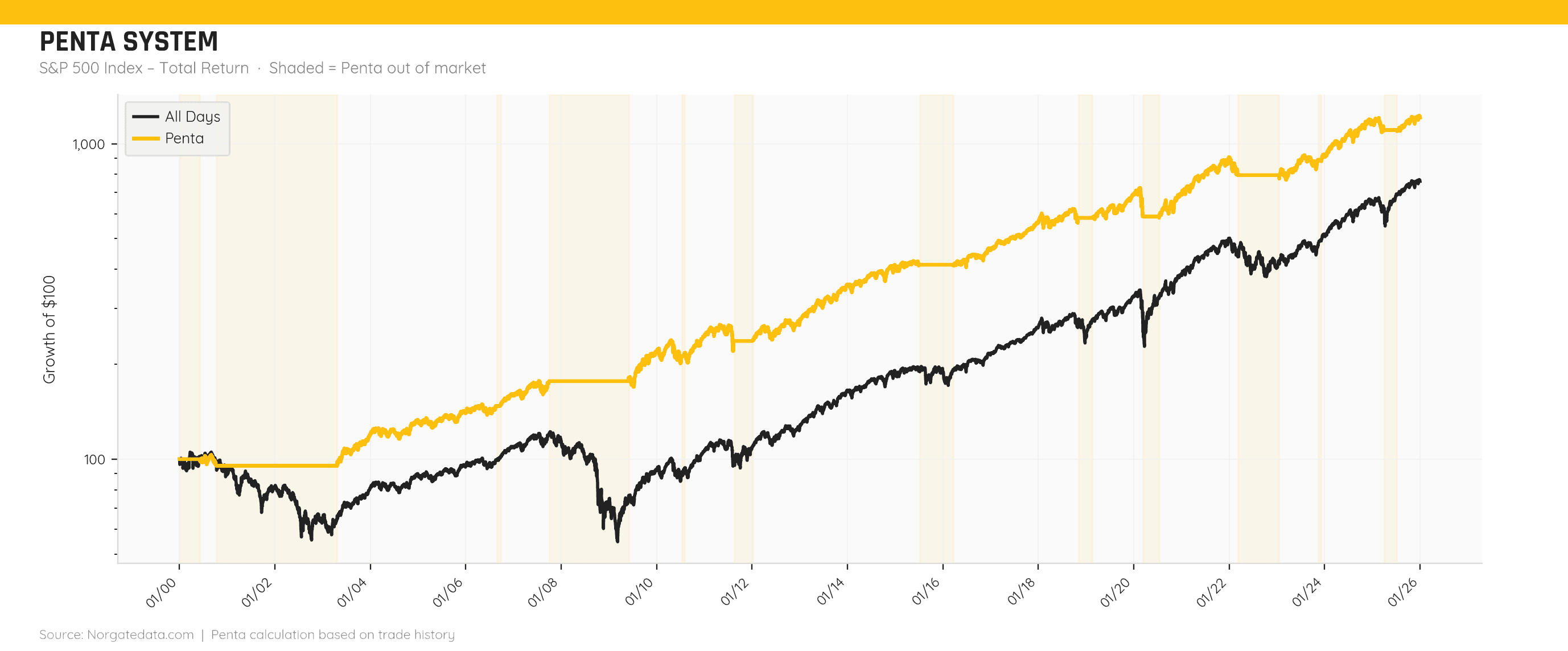
Source: Norgate Data | Penta Calculation is based on historical back tests
By systematically focusing on risk reduction, Penta exits the market when conditions deteriorate, and re‑enters when trends improve. In doing so, it naturally misses the majority of both the best and worst market days. This outcome is intentional rather than accidental.
Notably, Penta missed approximately 92 percent of the best days, roughly 76 percent of the worst days, and 84 percent of both extremes combined.

Source: Norgate Data | Penta Calculation is based on historical back tests
This reinforces a key point often overlooked by buy‑and‑hold advocates. Many of the best days occur during periods when volatility is already elevated and risk is highest.
Risk and Return: Why Drawdowns Matter More Than Charts
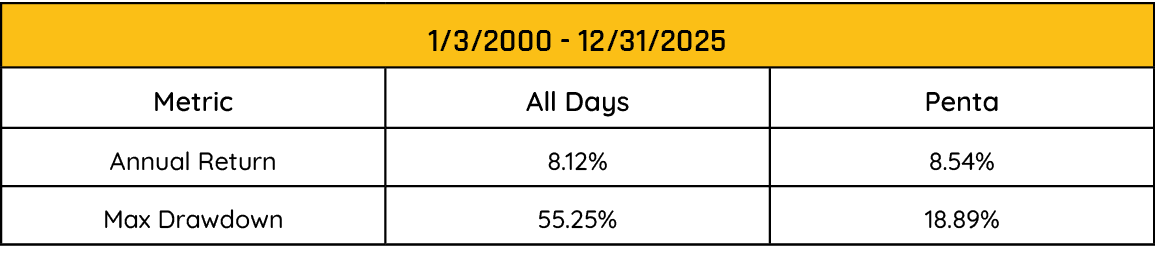
Another critical element frequently ignored in passive investing discussions is drawdown. Buy‑and‑hold frameworks assume investors can endure large and prolonged declines while waiting for eventual recovery.

Source: Norgate Data | Penta Calculation is based on historical back tests
Despite missing nearly all of the market’s best days, Penta delivered a higher annual return than buy and hold. This outcome challenges the belief that full market participation is required to achieve long‑term growth.
Source: Norgate Data | Penta Calculation is based on historical back tests
If an investor cannot tolerate the drawdown, the theoretical return becomes irrelevant. Risk and return must be evaluated together rather than in isolation.
Why Timing > Time In
The discussion around timing and time invested is often oversimplified. Long-term market participation is important, but constant, unmanaged exposure can lead to drawdowns many investors cannot endure.
Risk aware investment approaches focus on managing exposure as market conditions change, helping investors stay invested over the long run.
That is why Timing > Time In is not just a catchy phrase. It is a practical framework for delivering outcomes that real investors can achieve.