
Is AI Behind the Jobless Boom?
Corporate profits are up 20.8% while private hiring has barely moved. Is AI the reason?
Corporate earnings have been nothing short of stellar, and yet the labor market appears to be stuck in the doldrums. On a year-on-year basis, profits are up 20.8% while private employment grew by just 0.5%. With companies spending heavily on artificial intelligence (AI) and other productivity-enhancing technologies, a natural question is whether AI is allowing companies to grow without adding nearly as many workers.
For the market side of this story, see our recent look at how investors are weighing earnings, rates, and AI spending.
Historically, profits and employment have tended to rise together. Looking across more than seven decades of data, we find that corporate-profit growth tends to precede private-employment growth about two quarters later.
Figure 1. U.S. Corporate Profits vs. Private Sector Employment
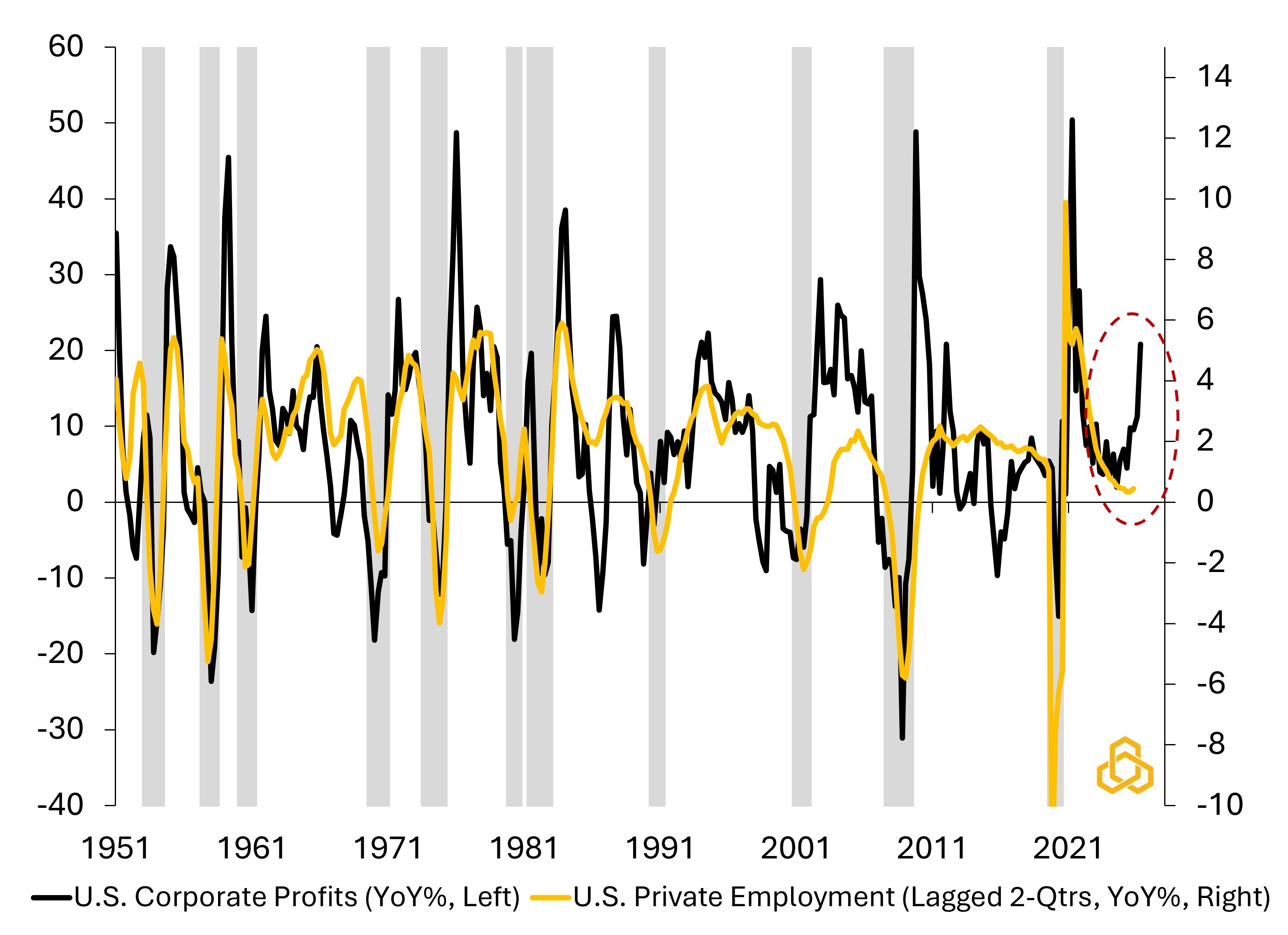
Sources: Bureau of Economic Analysis, Bureau of Labor Statistics, Bloomberg L.P., and Potomac. Data as of 2Q 2026 for profits and September 2026 for employment. Note1: Corporate profits are BEA National Income and Product Accounts. Note 2: Shaded regions denote periods of U.S. recession.
Based on this relationship, employment growth should be closer to 2.0% year-on-year according to where profits are today. That would be roughly equivalent to 235,000 to 240,000 private sector jobs added per month. Instead, the economy has added an average of just 74,000 per month in 2026. In fact, employment has remained below its profit-implied growth rate for over 11 consecutive quarters now, the longest sustained profit-implied hiring shortfall in our postwar data outside recessions and the first two years following a recession.
Figure 2. Actual Private-Employment Growth Minus Profit-Implied Growth (ppts)

Sources: Bureau of Economic Analysis, Bureau of Labor Statistics, Bloomberg L.P., and Potomac. Data as of 2Q 2026. Note 1: Profit-implied employment growth is estimated from the historical relationship between year-on-year NIPA corporate-profit growth and year-on-year private-employment growth, with corporate profits leading employment by two quarters. Negative readings indicate employment growth below the profit-implied rate. Note 2: Corporate profits are BEA National Income and Product Accounts. Note 3: Shaded regions denote periods of U.S. recession.
Interestingly, the closest comparison may be the aftermath of the dot-com bubble. Following the 2001 recession, surging productivity allowed businesses to increase output while keeping payroll growth subdued. In early 2004, then-Federal Reserve Governor Ben Bernanke argued that strong productivity allowed firms to satisfy demand with fewer workers, contributing to what became known as the “jobless recovery.” The numbers looked surprisingly similar to today: profits were growing nearly 26% while employment rose just 0.5%.
We have drawn similar parallels between today’s AI boom and the 1990s in our work on bond diversification.
One important difference is timing. The 2004 episode was still part of the extended recovery from the 2001 recession. Today we are more than six years removed from the 2020 downturn. As figure 1 suggests, it is possible that the weak growth in employment could simply be following the traditional lag, but if payrolls do not pick up in 2027, then we may need to recognize that something else may be suppressing the normal transmission from profits to payrolls.
Are There Not Enough Workers?
Labor supply offers another possible explanation, as official data show the U.S. labor force contracting. Lower immigration and an aging population are likely slowing growth in the available workforce, and the St. Louis Fed estimates that only 15,000 to 87,000 jobs per month may now be needed to keep unemployment unchanged.
Figure 3. Total U.S. Labor Force Growth (Year-on-Year Percent Change)

Sources: Bureau of Labor Statistics, Bloomberg L.P., and Potomac. Data as of September 2026. Note: Shaded regions denote periods of U.S. recession.
But even that picture is murky. A sizable BLS population adjustment in January 2026 reduced the estimated labor force by roughly 1.4 million, meaning some of the apparent contraction reflects a statistical break rather than workers suddenly disappearing from the economy.
We see weaker labor supply as part of the story, but not a decisive one. If workers were genuinely scarce while businesses remained eager to hire, we would expect stronger wage growth and more visible competition for labor. Instead, wage growth has moderated, and hiring remains subdued outside of specialized trades like licensed electricians to aid in AI data-center construction, even as profits and productivity rise.
That leaves an uncomfortable possibility: businesses may not need as many workers.
Looking for Clarity in the Year Ahead
At the end of the day, we don't have an answer yet. Hiring may simply be late, reduced labor-force growth may be limiting payroll gains, or AI and other productivity-enhancing technologies may be allowing companies to grow with fewer incremental workers. The year ahead should help distinguish among them.
If the labor force stabilizes, profits remain strong, wages stay contained and hiring still fails to respond, the case for blaming labor supply or a simple hiring lag becomes harder to make. At that point, pointing the finger at AI may become increasingly justified.

