We are genuinely getting tired of writing about inflation. It has become the houseguest that just won't leave. Fortunately, we did get some signs that it may finally be putting on its coat, with headline consumer prices falling from 4.2% year-on-year to 3.5% in June. Core CPI inflation also finally started heading for the door, with the index dropping from 2.9% to 2.6%.
Each of these developments is encouraging, but can investors finally relax? Probably not quite yet. While the report was better than expected, oil prices have picked up again as tensions in the Strait of Hormuz have reignited, raising the risk that inflation progress stalls in July (see figure 1).
Figure 1. U.S. Consumer Price Index vs Retail U.S. Gas Prices (YoY%)

Sources: Bureau of Labor Statistics, American Automobile Association, Bloomberg L.P., and Potomac. Data as of June 2026 for CPI and July 14, 2026 for Retail Gas Prices.
We would also point out that inflation remains well above trend and that the Federal Reserve will likely want to see a sustained improvement in core services inflation excluding housing, often referred to as supercore inflation, before declaring victory. After trending higher for four consecutive months, the metric fell by 0.5 percentage points year-on-year in June, but it remains roughly a full percentage point above pre-pandemic levels (see figure 2). Further progress in this gauge is particularly important because it represents roughly 55% of core PCE inflation.
Figure 2. PCE Services Inflation Excluding Energy and Housing (YoY%)

Sources: Bureau of Economic Analysis, Bloomberg L.P., and Potomac. Data as of June 2026.
Both Governor Waller and Chair Warsh alluded to this in their recent speeches, with Waller noting that he "will need to see several months of lower readings to feel that inflation is moving in the right direction." The common message from both policymakers was that one encouraging inflation report does not mean the job is finished.
Following the better-than-expected report, the market is no longer viewing the Fed's July 29 meeting as a "live" meeting where interest rates could change, but it still expects at least one rate hike before year-end. Aside from the Fed meeting, the next key inflation date will be July 30, when the Fed's preferred measure of inflation, the personal consumption expenditure (PCE) deflator, will be released.
The Inflation Hangover
Few years illustrated the old market adage, "Don't fight the Fed," better than 2022, when neither the stock market nor the bond market posted positive returns for the year. One side effect of higher inflation is a rising positive correlation between stock and bond returns. As a result, the two asset classes tend to move together, reducing the traditional diversification benefit of holding bonds.
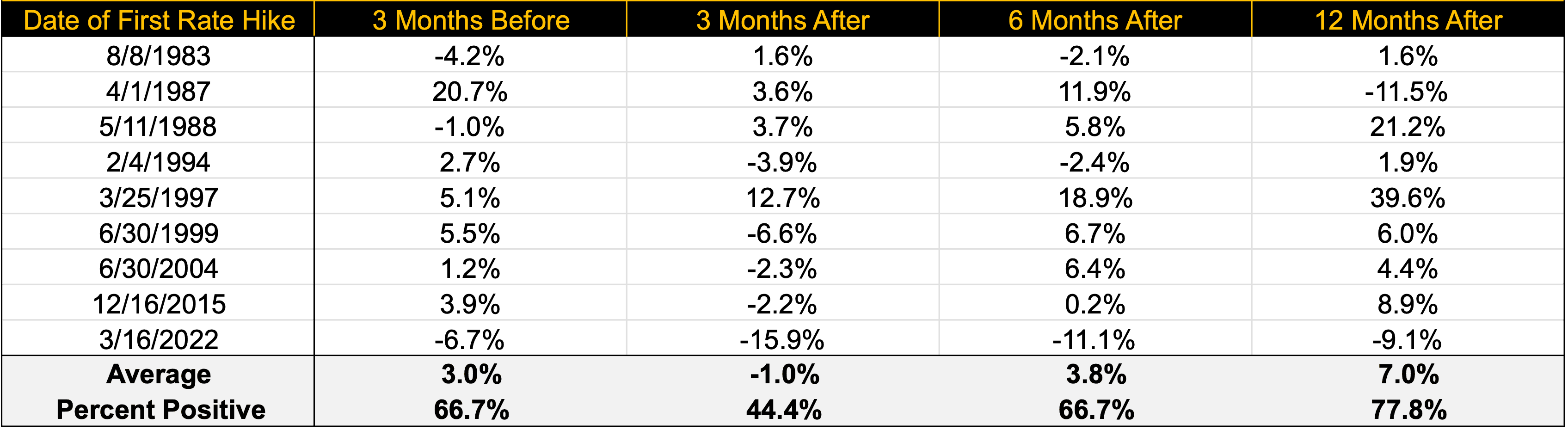
That said, the first Fed rate hike rarely results in a deep market drawdown. While the S&P 500 posted positive returns just 44% of the time during the three months following the first Fed rate hike, outside of 2022 the largest decline was a manageable 6.6%. In fact, excluding 2022, the average return during the three months following the first hike was a modest gain of 0.8%. One year later, the S&P 500 has posted positive returns roughly 78% of the time, with an average return of 7.0% (see figure 3). Just like any party, it often takes a while to fully recover.
Figure 3. S&P 500 Performance Before and After First Fed Rate Hikes
Sources: Standard & Poor’s, Bloomberg L.P., and Potomac. Data as of March 16, 2023. Past performance is no guarantee of future results. It is not possible to invest directly in an index.
The same pattern generally holds true for technology stocks, although with a few important caveats. The initial drawdown tends to be somewhat deeper because technology companies are more sensitive to higher interest rates, given that much of their expected earnings lie further in the future. The other caveat is that return dispersion in technology stocks is greater than for the broader S&P 500. If the outsized gains during the Tech Bubble are excluded, technology stocks averaged a decline of 2.5% one year after the first Fed rate hike, with positive returns occurring just 43% of the time (see figure 4).
Figure 4. NASDAQ Performance Before and After First Fed Rate Hikes

Sources: NASDAQ, Bloomberg L.P., and Potomac. Data as of March 16, 2023. Past performance is no guarantee of future results. It is not possible to invest directly in an index.
Given that the current backdrop most closely resembles the mid-to-late 1990s in terms of the Artificial Intelligence buildout, continued gains across the technology sector would not be surprising. However, it also would not be surprising to see investors become increasingly selective. The recent divergence between the Magnificent Seven and semiconductor stocks may already be an early sign of this (see figure 5).
Figure 5. Philadelphia Semiconductor Index vs. the Mag-7 (YTD% Return)

Sources: NASDAQ, Bloomberg L.P., and Potomac. Data as of March 16, 2023. Past performance is no guarantee of future results. It is not possible to invest directly in an index.
If Chair Warsh is correct that "the inflation surge of the last five years will be a thing of the past," then the next phase of this bull market may look very different from the last. Rather than simply rewarding exposure to a handful of themes, investors may once again find themselves in a market where company fundamentals, earnings execution, and valuation matter more than broad technological trends.
Weekly “Keeping it Strait” Highlights:
· Traffic in the Strait has slowed down to a trickle. After a brief reprieve, oil prices have been pushing higher again and gasoline prices will likely follow. We doubt there is a desire to keep this going forever, but for now, it looks like two steps forward, one step back.
· Inflation gauges like the Cleveland Fed Nowcast and the 1 year breakeven rate improved after the Consumer Price Index came in better-than-expected in June. That could reverse a bit in July given the renewed rise in energy prices.
· The two-year Treasury yield fell by 9 basis points with the June inflation print reducing some of the urgency for a Fed rate hike. Markets still expect at least one rate hike, but the July FOMC meeting is no longer considered to be “live.”


